Debian

  1. Transitioning to a new OpenPGP key

    By Andrej Shadura

    Following dkg ’s example, I decided to finally transition to my new ed25519/cv25519 key.

    Unlike Daniel, I’m not yet trying to split identities, but I’m using this chance to drop old identities I no longer use. My new key only has my main email address and the Debian one, and only those versions of my name I still want around.

    My old PGP key (at the moment in the Debian keyring) is:

  2. Vendoring Rust dependencies for a Debian derivative

    By Andrej Shadura

    Recently, I needed to package a Rust crate libslirp for a Apertis, a Debian derivative. libslirp is used by the newly release UML backend of debos, our Debian image build tool. Unfortunately, this crate hasn’t yet been properly packaged for Debian proper, so I could not simply pull the packaging from Debian. Even worse, its build dependencies haven’t all been packaged yet. Most importantly, I have only uploaded zbus to Debian today, and at that time none of its dependencies were in Debian either.

  3. Using gcc sanitisers to get a nasty bug fixed

    By Andrej Shadura

    A couple of days ago a colleague at Collabora asked me to help create a Debian package for the tool he needed to complete his task. The tool happened to be an NXP code signing tool, used to sign OS images to be run on i.MX systems using ‘High Assurance Boot’.

    As it often happens, the tool was distributed in a manner typical for many big corporations: no direct link to the tarball, custom buildsystem, compiled binaries in the same tarball as the sources. A big relief was that the tool has been distributed under a three-clause BSD license since version 3.3.0 (the sources were not provided at all before that).

  4. resvg: worth having in Debian?

    By Andrej Shadura

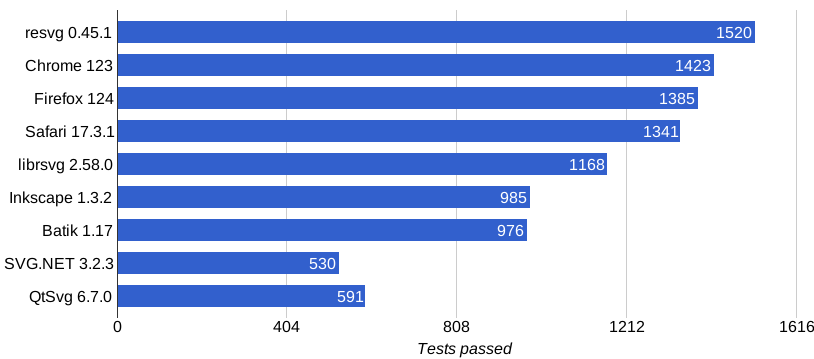
    Yesterday I have discovered resvg, an MPL 2.0-licensed SVG rendering and optimisation library and a tool, written in Rust. It is said to be faster than some SVG renderers while currently slower than librsvg. It aims to support the static subset of SVG better than other libraries:

    SVG test suite results: resvg 1272, Inkscape 967, librsvg 998

    The author writes:

    One of the major differences from other rendering libraries is that resvg does a lot of preprocessing before rendering. It converts shapes to paths, resolves attributes, removes groups and invisible elements, fixes a lot of issues in malformed SVG files. Then it creates a simple render tree with all elements and attributes resolved. And only then it starts to render. So it’s very easy to implement a new rendering backend.

  5. wpa-supplicant and hostapd 2.7 in Debian

    By Andrej Shadura

    Hostapd and wpa-supplicant 2.7 have been in Debian experimental for some time already, with snapshots available since May 2018, and the official release since 3 December 2018. I’ve been using those 2.7 snapshots myself since May, but I do realise my x250 with an Intel Wi-Fi card is probably not the most representative example of hardware wpa-supplicant would often run on, so before I upload 2.7 to unstable, it would be great if more people tested it. So please try to install it from experimental and see if it works for your use cases. In the latest upload, I have enabled a bunch of new upstream features which previously didn’t exist or were still experimental, so it would be great to give them a go.

  6. Bye-bye binary vconfig(1)

    By Andrej Shadura

    This morning I have decided that this is the time. The time to finally remove the binary vconfig utility (which used to help people configure VLANs) from Debian. But fear not, the command isn’t going anywhere (yet), since almost six years ago I’ve written a shell script that replaces it, using ip(8) instead of the old and deprecated API.

    If you’re still using vconfig, please give it a test and consider moving to better, newer ways of configuring your VLANs.

  7. How to stop gnome-settings-daemon messing with keyboard layouts

    By Andrej Shadura

    In case you, just like me, want to have a heavily customised keyboard layout configuration, possibly with different layouts on different input devices (I recommend inputplug to make that work), you probably don’t want your desktop environment to mess with your settings or, worse, re-set them to some default from time to time. Unfortunately, that’s exactly what gnome-settings-daemon does by default in GNOME and Unity. While I could modify inputplug to detect that and undo the changes immediately, it turned out this behaviour can be disabled with an underdocumented option:

  8. Community time at Collabora

    By Andrej Shadura

    I haven’t yet blogged about this (as normally I don’t blog often), but I joined Collabora in June last year. Since then, I had an opportunity to work with OpenEmbedded again, write a kernel patch, learn lots of things about systemd (in particular, how to stop worrying about it taking over the world and so on), and do lots of other things.

    As one would expect when working for a free software consultancy, our customers do understand the value of the community and contributing back to it, and so does the customer for the project I’m working on. In fact, our customer insists we keep the number of locally applied patches to, for example, Linux kernel, to minimum, submitting as much as possible upstream.

  9. A bit more on TrueCrypt

    By Andrej Shadura

    Few days ago I was discussing my last blog post with a colleague of mine, Lukaš Tvrdý, and he’s mentioned that it actually is possible to harmlessly decrypt the TrueCrypted filesystem in online mode, resize it, and encrypt it back again. Well, I decided to try, because I have had some problems with that setup. Apart from init script reordering I had to make (not covered in the post, as I did it later and haven’t found time yet to write about that), I ran into a trouble while trying to enable swapping. As the only partition I had was formatted into NTFS, placing a swap file there isn’t the best idea ever. I actually tried doing so, but after two deadlocks I had in few hours I had to rethink that. Indeed, as NTFS is implemented in the user space using ntfs-3g, as soon as this process gets swapped out, the system is left helpless. The swap is on the file system driver of which is in the swap, which is on the file system driver of which is… well, you get the idea.

  10. ifupdown news

    By Andrej Shadura

    A new version of ifupdown has been uploaded to experimental yesterday, which brings some important changes.

    First of all, now it’s possible to specify default values for various interface configuration options. This eliminates the need of hard coding of them in C source, as Ubuntu has been doing for some time. End users are not affected by this change at all, of course.

    Second, now ifup behaves differently when it’s called with --all option. Previously, that was causing all interfaces marked as ‘auto’ to be brought up. Now, it does exactly the same if --allow option isn’t used. Otherwise, it brings up the interfaces which are declared to belong to a specified class using allow-* directive. In other words, ‘auto’ directive indeed declares interface as belonging to a class ‘auto’, and the default class for ifupdown is also ‘auto’, so when user runs ifup -a only those interfaces are brought up.